Aktaṛï ṛolulo le, kpotsïḷo, Ṛamte medzeena tili. Ṣoṛï tedza, “Dźo vetëḷ, ṛa ṛa evi dzedze totë sutë ṭoṭoṛï, ṛa evi ne miïḷï dzeadze totë akpe esa piṣṭëḷ iḷïï no sutë kudzïï iḷïï totë.”
I-I know you’re a private man, Bhaiyya,” Akthar says, his oddly quiet voice and downcast eyes pulling Ram back to him quicker than a fish tugging on a lure. “I’m not always sure where your line is drawn.”
aktad-ṛi ṛol-uḷo le kpotsi-uḷo ṛam-te me-udzo-ø-ana tilu-ø
Akhtar-SG.MV be.shy-IMP away.from.us murmur-IMP Ram-SG.ST PASS-pull-PFV-RES pay.attention-PFV
For Atsi I’m working on clause chaining with the aspects. It’s tenseless. But, it’s got the kind of aspect w/ inceptive, progressive, etc. and viewpoint aspect in spades. The main device for sequencing narrative in Atsi is the aspects. This highlights the aspects of the various verbs in the translation of the above.
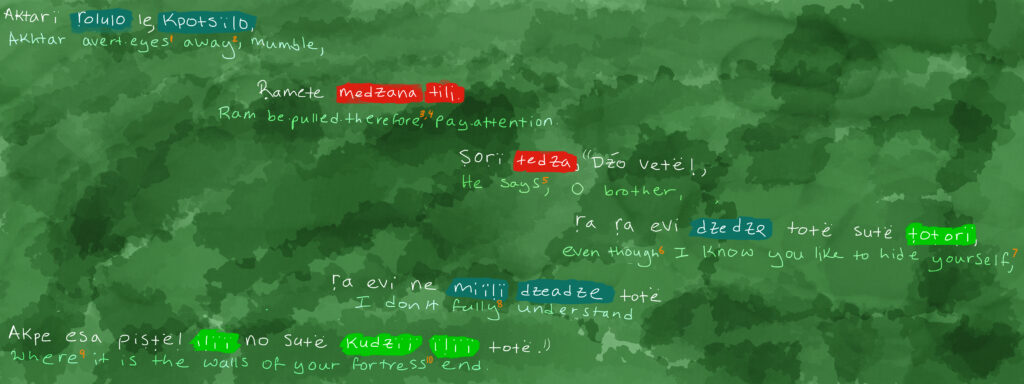
Key
Red is perfective, which is a whole event viewed entire. Here it’s the unmarked form, but really it will be marked in future versions. All events are perfective. Red is chosen to stand out.
Teal is imperfective, which in Atsi means ‘backgrounded’ happenings – what is going on while the main action given by the perfective happens. In the LCC video I described them as waves in the lagoon, the boundaries of which are described by the perfective verb. The colour matches ocean waves; in the first draft of the image there were waves going off to the left and right of the teal parts.
Green is for ‘habitual’, i.e. things that are viewed as always being true, past, present, future, just a general property of space. It is coloured that way to match the background.
Events
Ram is pulled in, and Akhtar says what he says.
- Pulled in
- ‘Medzeena tili‘ is really two verbs, one of which is aspectual. Ram ‘pays attention’ (‘medzeena‘), which is one event, but ‘be.pulled’ (’tili’) is used to describe the manner, as part of a serial verb construction ‘X pulls Y (to) do Z’, which expresses (external) causation.
- It’s passivized, so X (Akhtar’, specifically his’s mumbling & eye aversion) isn’t explicit, so here it just describes Ram’s response. To top that off, the verb ’tili’ includes a suffix which specifies that this event is a direct consequence of some other event in the general discussion. Since this isn’t a deliberate outcome on Akhtar’s part (and he’s not even a subject anymore due to the passive), I left it off the optional pro-clitic which goes on the inciter, i.e. him – this feels right.
Underliers
- Akhtar’s emotional stance
- What causes (and slightly precedes) Ram paying attention is Akhtar’s emotional stance, which he holds during the entire thing. So these verbs of averting eyes and mumbling get imperfective aspect.
- Akhtar’s current knowledge
- In ‘I am currently aware of your nature…’ and ‘I am still not being able to find out… where your boundaries are drawn’, the emphasis on the ongoing phenomenon – which is only relevant now, specifically, not throughout all time – calls for the imperfective aspect. The second one really reads, in non-standard English, ‘Even though I am knowing you are private, I am not understanding where…’.
Truths
- Ram’s natures
- ‘You are a private man’ describes just a general thing about Ram, and one not likely to change, so it gets the habitual.
- The last line is literally ‘FOCUS where fortress it.is at you be.silent it.is here’, meaning ‘your fortress, where is the place it ends/is silent’.
- Since it is constantly Ram’s ‘fortress’ (metaphorical, the region inside being of coure the part of his personality that’s private), the fortress’ belonging to him is described in the habitual.
- Since the place he stops keeping information inside is also felt to be unchanging, the location of the fortress, and it’s termination there, are also described in the habitual.
Pronoun Ambiguity
The third line of this starts with ‘he says’, but there is no possible ambiguity about which ‘he’ is saying it the Atsi translation. Besides the inherent logic, Akhtar is introduced in the mobile noun class (as he’s being fidgety), and Ram is introduced in the default noun class – as this is a moving class pronoun, it’s obvious who is saying something. Akhtar gets the moving class because he is responsive to Ram, and hence inherently more mobile, and because he is fidgeting. If their relationship were unequal – which it’s not -, he could have the body needs noun class to indicate he is in service to Ram.